Hà My beach: what it's like and when to swim
Hà My beach is the open stretch of sand that runs north from An Bang towards Da Nang, with a coconut grove behind it and few buildings along it. We write about it from the resort that opens onto it: what you will and won't find on the sand, which months the sea tends to be calm, and why a sea that looks calm is not always a safe one.
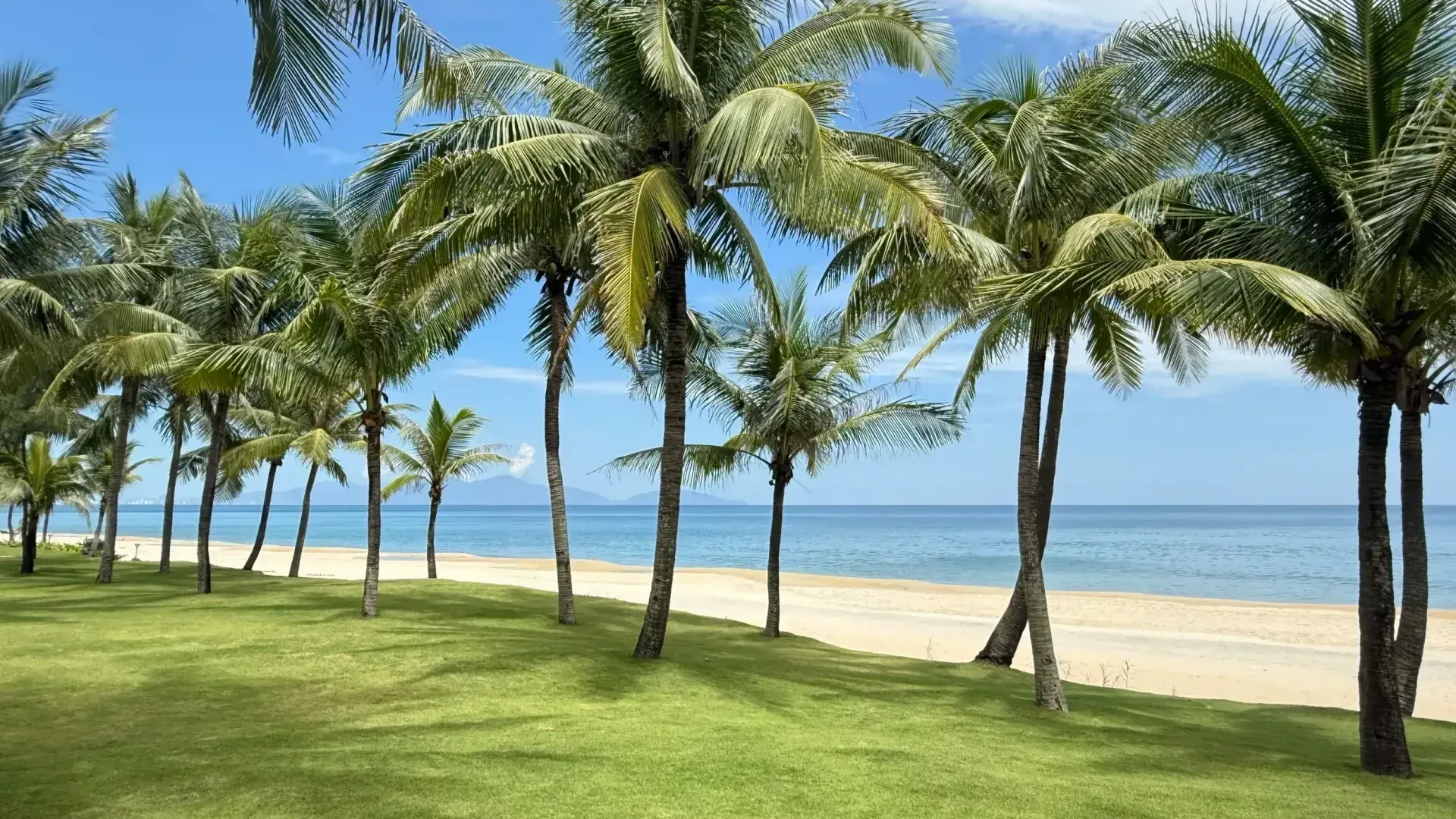
What is Hà My beach like?
Long, open and quiet. When the Vietnamese press wrote about it in 2017, it described an unspoilt beach of clear blue water and white sand, with no water-sports services yet, ideal for people who don't like noise and crowds.1011 Those are snapshots from 2017, not a description of today.
The same reports said that Britain's Telegraph had put Hà My on a list of Asia's best beaches.11 We have not been able to open the original list, so we pass it on as the Vietnamese press reported it that year, but without a position: the reports themselves don't agree on one.
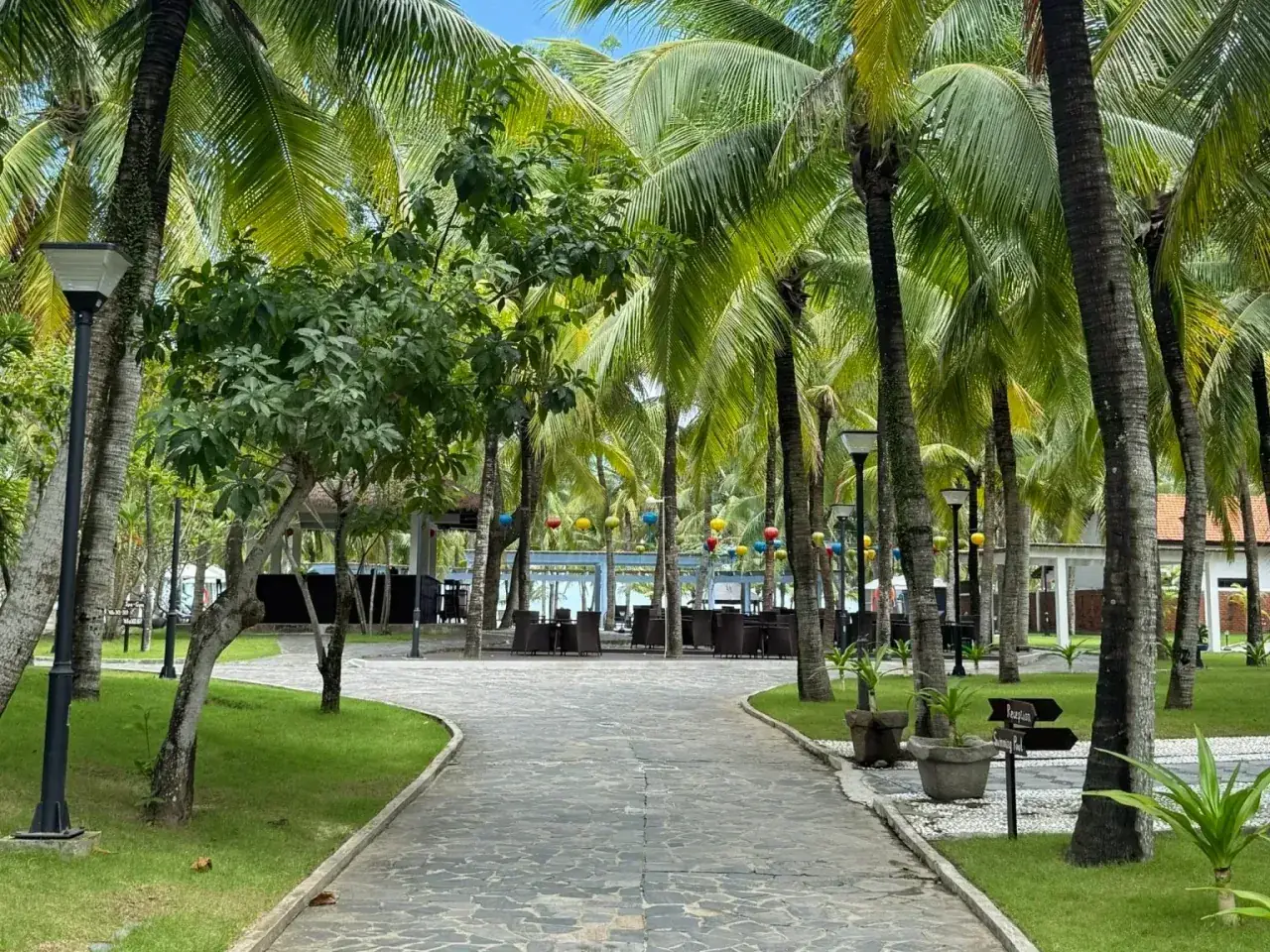
What we can tell you first-hand is about the stretch in front of the hotel. It is one of the least built-up between Hoi An and Da Nang, and one of the quietest, with far fewer people than the beaches next to town. Brick paths run from the room blocks through the coconut grove to the beach gate, past hammocks slung between the trunks, and you reach the sand without crossing a public road.
Where is Hà My beach, and how far is it from Hoi An?
On the coast between Hoi An and Da Nang, on the stretch that runs north from An Bang. On paper, it changed jurisdiction in 2025. On 12 June Vietnam's National Assembly approved merging Quang Nam province and the city of Da Nang into a single city of Da Nang, from 1 July,8 and five former wards of Điện Bàn, Điện Dương among them, became the ward of Điện Bàn Đông.9 If a recent map says Da Nang and an older guide says Quang Nam, they are describing the same beach.
From the hotel, the old town of Hoi An is 12 minutes and about 8 km by road, Da Nang airport 25 minutes and about 20 km, and the centre of Da Nang 30 minutes and about 25 km. The Marble Mountains are 15 minutes away, and the distances from Hà My to the rest of the area are on our page about the destination.
An Bang, just to the south, is the better-known beach. In TripAdvisor's 2024 Travelers' Choice awards, chosen by its readers, it came fifth among the best beaches in Asia,12 and its seafront has many hotels, villas, homestays and restaurants.13 Hà My is the other kind of beach: much less built up, and much quieter.
When is the best time to swim at Hà My?
From April to August. Those are the sunniest months at the Da Nang weather station, with between 209 and 247 hours of sunshine each,1 and they fall outside the season of large waves, which on this coast usually runs from September to March. The city counts the shore from Da Nang down to Điện Bàn and Hoi An among those hit hardest by big waves and a shifting shoreline, and September to November are the months of the major storms.2
The same data, as a table
| Month | hours |
|---|---|
| January | 132 |
| February | 146 |
| March | 182 |
| April | 209 |
| May | 247 |
| June | 242 |
| July | 246 |
| August | 215 |
| September | 177 |
| October | 143 |
| November | 118 |
| December | 95 |
The air is warm all year: on average 21.5 °C in January, the coolest month, and 29.4 °C in June, the warmest.1 We don't give sea temperatures: the figures that circulate online don't say where they come from, and they don't agree with each other.
| Months | Average air temperature | The sea2 | Boats to Cù Lao Chàm17 |
|---|---|---|---|
| December to February | 21.5–22.4 °C | Large-wave season | Most tourist boats don't run |
| March | 24.2 °C | Last month of the large-wave season | The best months begin |
| April to August | 26.5–29.4 °C | Outside the large-wave season | Best months: clear skies, a calm sea, little rain |
| September to November | 24.4–27.6 °C | Large waves, and the months of the major storms | Most tourist boats don't run |
Outside those months, swimming can be stopped altogether. On 26 October 2024, with Typhoon Trami approaching, the board that manages Da Nang's central tourist beaches suspended sea bathing and water sports until further notice.7 Floods bring their own trouble: in November 2023 rubbish carried down by the Thu Bon covered more than 2 km of An Bang, and swimming there was banned because of the big waves.13 For what the rainy months are like away from the beach, we have a guide of its own.
Is it safe to swim at Hà My?
It can be, if you read the sea and keep to the rules. The danger on this coast is the rip current, which pulls swimmers away from the shore. A Da Nang lifeguard explained in 2024 that rips appear at the change of season, and that their calm, waveless water is exactly what makes people think a patch is safe. The head of the board that manages Da Nang's tourist beaches set out the rules: don't swim in big waves or when you are tired, obey the lifeguards' whistles and flags, and never swim where no white-capped waves are breaking, because that is where the rip runs.3
On Da Nang's central beaches, such as the one in front of Biển Đông Park, bathing areas are marked with flags, signs and lines of buoys, and lifeguard teams of four to six work from 04:30 to 19:00. In the first half of 2026 they rescued 25 bathers, and nobody drowned on the beaches they cover.4 The advice there is to swim between the buoys where lifeguards are on duty, and to come out when the end of their shift is announced.5 Those are the city's central beaches, though, not Hà My.
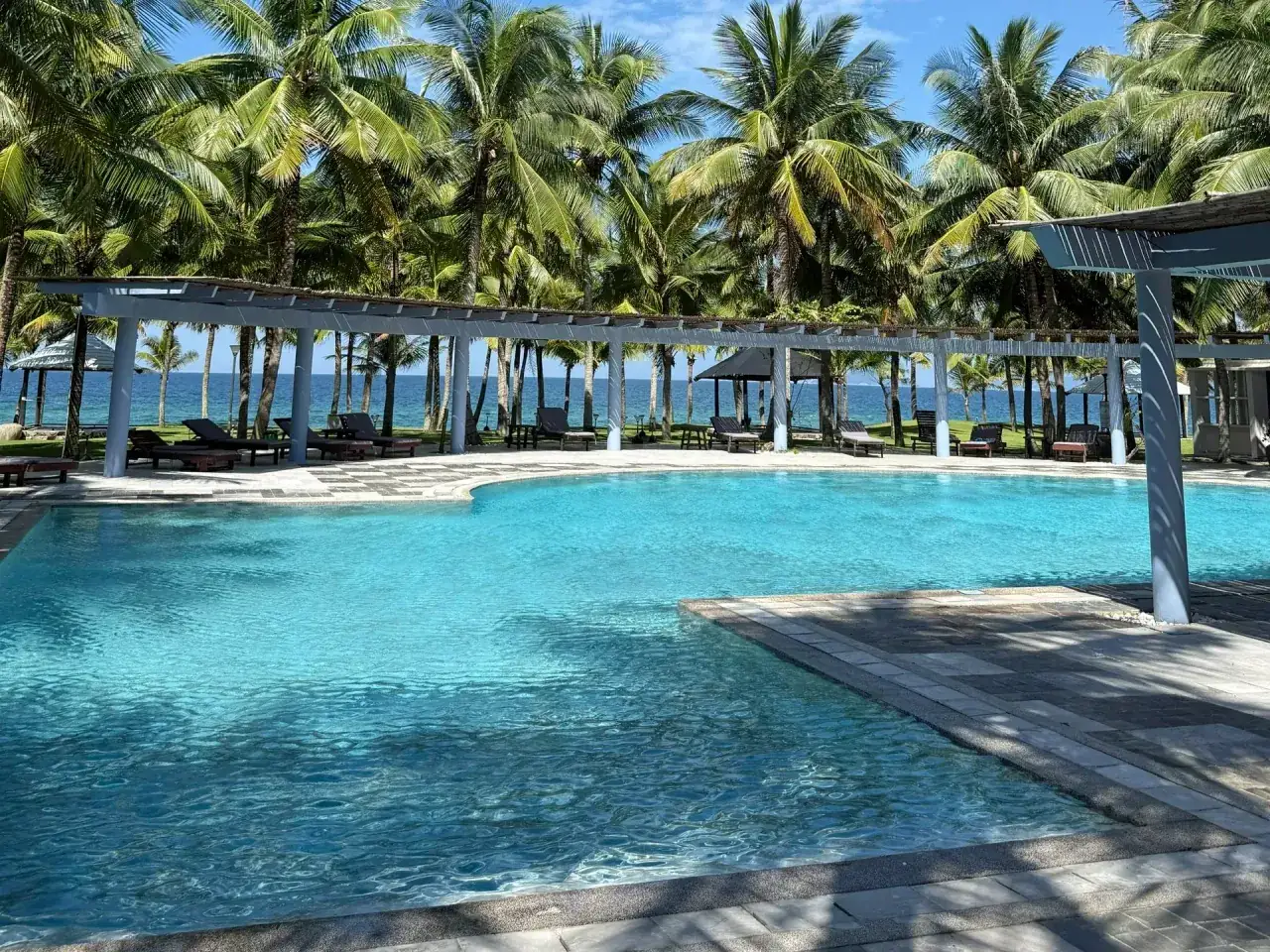
Hà My has had its own reminders. Between 5 and 12 April 2026, three men saved 13 people from drowning at Thống Nhất and Hà My beaches, and the ward of Điện Bàn Đông honoured them for it. Two belong to the Thống Nhất beach rescue team; the third, a security guard at another resort on this coast, gave CPR to a bather at Hà My on 5 April. The ward's advice afterwards was to limit swimming in dangerous areas and to follow the instructions of the beach board and the lifeguards.6
On the hotel's stretch there is no lifeguard and, as far as the hotel knows, there is none on the rest of Hà My either. The safe area is signposted on the sand; outside it, nobody swims, and swimming is on your own responsibility. If you are travelling with children, this is the line to read twice. Those are two of the hotel's four rules for the beach; the other two ask you to take back whatever you bring down, and to put the dunes, the palms and the people who work this coast first.
What is there on the sand, and what isn't?
On the hotel's beach nothing is set up: no loungers, no umbrellas, no beach bar. The shade and the hammocks are back in the coconut grove. The beach is cleaned, and it stays clean because of what nobody leaves on it, so whatever you take down to the sand comes back with you.
For a drink or something light, the Pool Bar beside the main pool is open from 10:00 to 19:00. Faifo, the restaurant, serves from 06:30 to 22:30, with the kitchen open until 22:00 and Hoi An dishes on the menu, and there is always somewhere open in the hotel between 06:30 and 23:00.
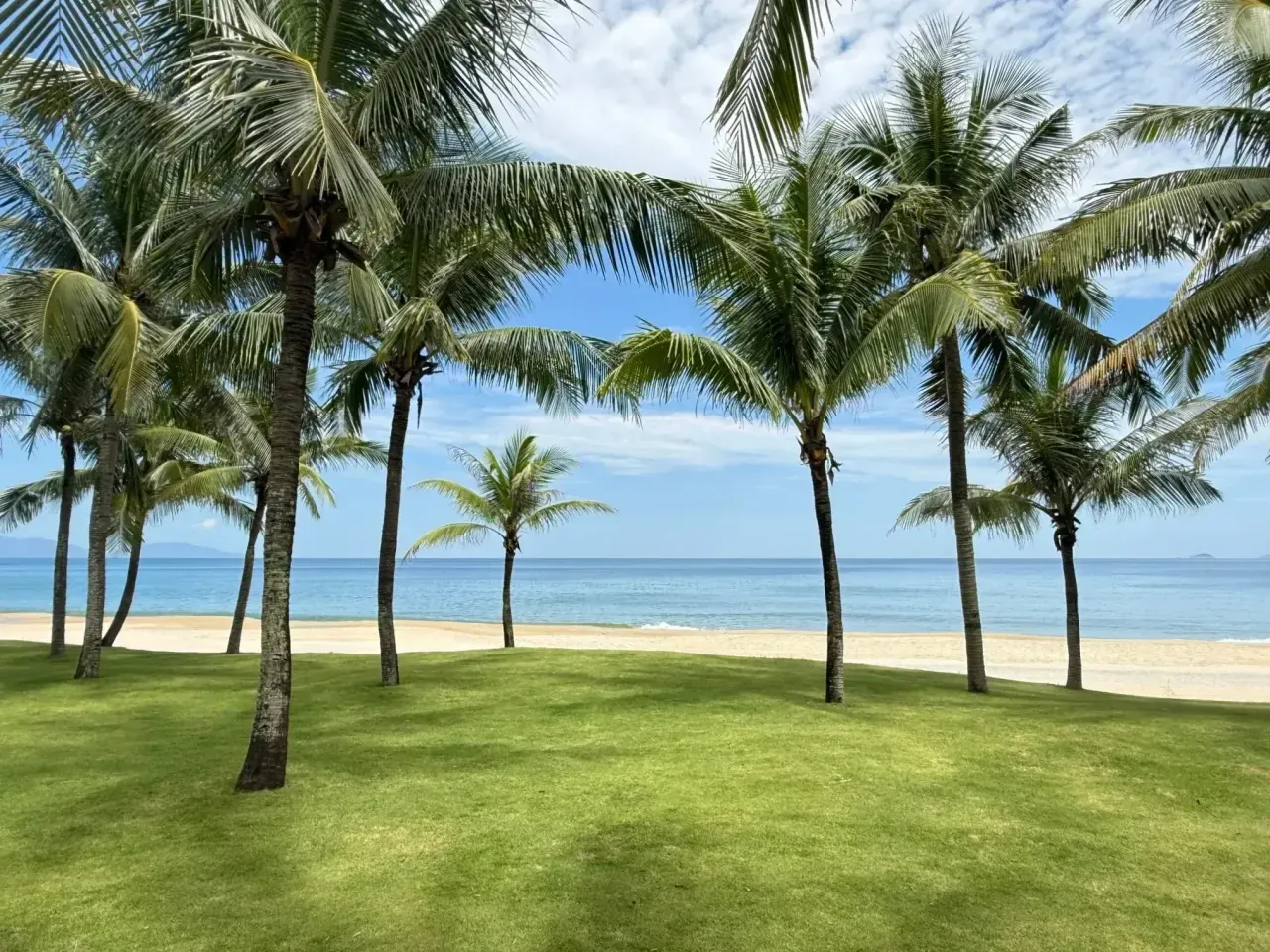
What is the island on the horizon?
Cù Lao Chàm, the Cham Islands: eight islands off this coast.14 Together with the old town of Hoi An they are the two core areas of a UNESCO biosphere reserve, recognised on 26 May 2009,16 which covers 33,475 hectares, most of them sea.15
Boats leave from the pier at Cua Dai, and the speedboat takes about 20 minutes.1718 The best months to go are March to August, when the sky is clear, the sea calm and there is little rain; in the rest of the year most tourist boats don't run.17 Around 3,000 people live on the islands.18
It's a day trip: you leave by boat in the morning and are back the same evening. It isn't a hotel product. Tell us you'd like to go and reception will help you arrange the day with whoever runs it, and tell you the price before you confirm.
Frequently asked questions
Is Hà My beach good for swimming?
Yes, from April to August: they are the sunniest months and fall outside the season of large waves, which usually runs from September to March. Swim only inside the marked area, never in big waves, and keep away from flat patches where no waves are breaking.
Is Hà My beach in Hoi An or in Da Nang?
Since 1 July 2025 it has been in the city of Da Nang, in the ward of Điện Bàn Đông; before that it was in Quang Nam province. The old town of Hoi An is 12 minutes away by road, and Da Nang airport 25 minutes.
Are there lifeguards at Hà My beach?
Not on the hotel's stretch, nor, as far as the hotel knows, on the rest of Hà My. Swimming is on your own responsibility: keep inside the marked area, and come out if the sea gets up.
Are there loungers or restaurants on Hà My beach?
Not on the hotel's beach: there are no loungers, umbrellas or beach bar. The shade and the hammocks are in the coconut grove, the Pool Bar beside the main pool is open from 10:00 to 19:00, and Faifo serves from 06:30 to 22:30.
How do you get to Cù Lao Chàm from Hà My?
By boat from Cua Dai: about 20 minutes by speedboat. The best months are March to August; in the others, most tourist boats don't run. Reception can help you arrange the day with whoever runs it, and tell you the price before you confirm.
Sources
- Ministry of Construction of Vietnam: QCVN 02:2022/BXD, national climate data for construction. Da Nang station, data from the Institute of Meteorology, Hydrology and Climate Change: average monthly hours of sunshine (table A.22) and average monthly air temperature (table A.2). The standard does not state the years the averages cover. (consulted )
- City of Da Nang: the effects of natural hazards and climate change (4 May 2026). Large waves usually from September to March; the coast from Da Nang to Điện Bàn, Hoi An and Duy Xuyên among the most affected by large waves and shoreline change; major storms from September to November. (consulted )
- Saigon Giai Phong: the drowning season (30 May 2024). A Da Nang lifeguard on rip currents at the change of season and on calm, waveless water mistaken for safe; the director of the Da Nang tourist beaches board on the rules: no swimming in big waves or when tired, obey whistles and flags, never swim where no white-capped waves break. (consulted )
- Saigon Giai Phong: safety on the beaches of central Vietnam (7 July 2026). Da Nang's central beaches: bathing areas marked with flags, signs and buoy lines; lifeguard teams of four to six from 04:30 to 19:00; 25 bathers rescued and no drowning deaths in the first half of 2026. (consulted )
- Nhan Dan: Da Nang keeps residents and visitors safe at sea (12 April 2023). Advice for Da Nang's beaches: swim in areas lined with safety buoys where lifeguards are on duty, and stop when the end of their shift is announced. (consulted )
- City of Da Nang: Điện Bàn Đông honours three men who saved 13 people from drowning (14 April 2026). Thirteen people saved at Thống Nhất and Hà My beaches between 5 and 12 April 2026, by two members of the Thống Nhất beach rescue team and a resort security guard; the ward's advice to limit swimming in dangerous areas and follow the beach board and lifeguards. (consulted )
- Tuoi Tre / Nguoi Lao Dong: Da Nang closes the road up the Son Tra peninsula (26 October 2024). On 26 October 2024 the board of Da Nang's tourist beaches suspended sea bathing and water recreation until further notice, ahead of Typhoon Trami. (consulted )
- Tuoi Tre News: the legislature approves the mergers that reduce Vietnam to 34 provinces and cities. Approved on 12 June 2025, in force from 1 July 2025: Quang Nam province and the city of Da Nang merge into the city of Da Nang. (consulted )
- Standing Committee of the National Assembly: Resolution 1659/NQ-UBTVQH15 (16 June 2025). Article 1(18): the wards of Điện Nam Đông, Điện Nam Trung, Điện Dương, Điện Ngọc and Điện Nam Bắc form the new ward of Điện Bàn Đông, from 1 July 2025. (consulted )
- VnExpress: the nameless beach in Quang Nam that made the British press (15 June 2017). Hà My in 2017: unspoilt, with clear blue water and white sand, on the coast road between Da Nang and Hoi An, still without water-sports services; reports it on a Telegraph list of Asia's beaches. (consulted )
- Bao Da Nang: Hà My, one of the most beautiful beaches in Asia (8 July 2017). Hà My as ideal for those who don't like noise and crowds; reports it on the Telegraph's list of top beaches in Asia, without a place in the list. (consulted )
- VOV: An Bang and My Khe among the top 10 beaches in Asia (22 February 2024). An Bang fifth among Asia's best beaches in TripAdvisor's 2024 Travelers' Choice awards, chosen by its readers. (consulted )
- VnExpress: An Bang beach buried in rubbish (15 November 2023). More than 2 km of An Bang covered with rubbish washed down the Thu Bon in the floods of November 2023; swimming banned because of big waves; many hotels, villas, homestays and restaurants on the beach. (consulted )
- Vietnam Biodiversity Conservation Agency: the Cu Lao Cham–Hoi An biosphere reserve. Cu Lao Cham consists of eight islands. (consulted )
- UNESCO: Cu Lao Cham–Hoi An biosphere reserve. Two core areas, the World Heritage old town of Hoi An and the Cu Lao Cham archipelago; 2009; 33,475 hectares, 26,777 of them marine. (consulted )
- Vietnam Government News: Cu Lao Cham marks 15 years as a world biosphere reserve (27 May 2024). Recognised by UNESCO's Man and the Biosphere council on 26 May 2009. (consulted )
- VnExpress: a travel guide to Cu Lao Cham (updated 14 July 2026). The speedboat takes 15 to 20 minutes; the best time to go is March to August, with clear skies, a calm sea and little rain; in the other months most tourist boats don't run. (consulted )
- VnExpress International: why you should visit the Cham Islands independently (2 August 2026). Boats from Cua Dai pier, about 20 minutes by speedboat; eight islands; around 3,000 residents. (consulted )