Best time to visit Hoi An: the months, and the dates for 2027
The best time to visit Hoi An is February to April: the driest stretch of the year, with about five days of rain a month and highs of 26 to 31 °C.1 If the beach comes first, April to August. Below, what each season gives you, and the dates that matter in 2027.

When is the best time to visit Hoi An?
We watch every season from a resort on Hà My beach that is open all year, 12 minutes from the old town, and the honest answer depends on what you come for. Hoi An is two trips in one, an old town you walk and a coast you swim off, and the two calendars only fully overlap in April.
The figures come from Vietnam's national climate data for construction, measured at the Da Nang station, the nearest one in the standard. The standard does not say which years the averages cover.1
The same data, as a table
| Month | % of days |
|---|---|
| January | 39 |
| February | 20 |
| March | 15 |
| April | 18 |
| May | 30 |
| June | 27 |
| July | 30 |
| August | 37 |
| September | 49 |
| October | 65 |
| November | 68 |
| December | 60 |
This is the number that decides most trips. From February to April it rains on between one day in five and one in six; in October and November, on two days out of three.
| Months | Average high1 | Days with rain a month1 | The sea2 | Good for |
|---|---|---|---|---|
| February to April | 26.2–31.0 °C | 4.8–5.6 | Large waves possible until March | The old town at any hour; the beach from April |
| May to August | 33.3–34.5 °C | 8.1–11.6 | Outside the large-wave season | The beach, early and late in the day |
| September to November | 27.4–31.8 °C | 14.6–20.3 | Large waves; the big storms usually come now | Short trips with a flexible plan |
| December and January | 25.0–25.1 °C | 12.0–18.7 | Large waves | The old town and the countryside, in cool weather |
What is Hoi An like from February to April?
Dry and mild. February is the coolest of the three, with highs around 26 °C and lows around 20 °C; by April the afternoons reach 31 °C, and the air is still humid, above 80 %.1 It is the season for walking the old town at any hour of the day and staying out by the river at night.
The sea is still finishing its rough months: large waves usually last until March.2 April is where the dry town and the calmer sea meet, and if you can only choose one month, it is the one we would choose.
On the 14th and 15th of every lunar month, people float small paper lanterns on the Hoài river, a custom that began in 1998, and the city's own guide puts the best time for it in what it calls the dry season, from March to September.3 On the 14th the town turns its electric light down and lets the lanterns take over.4
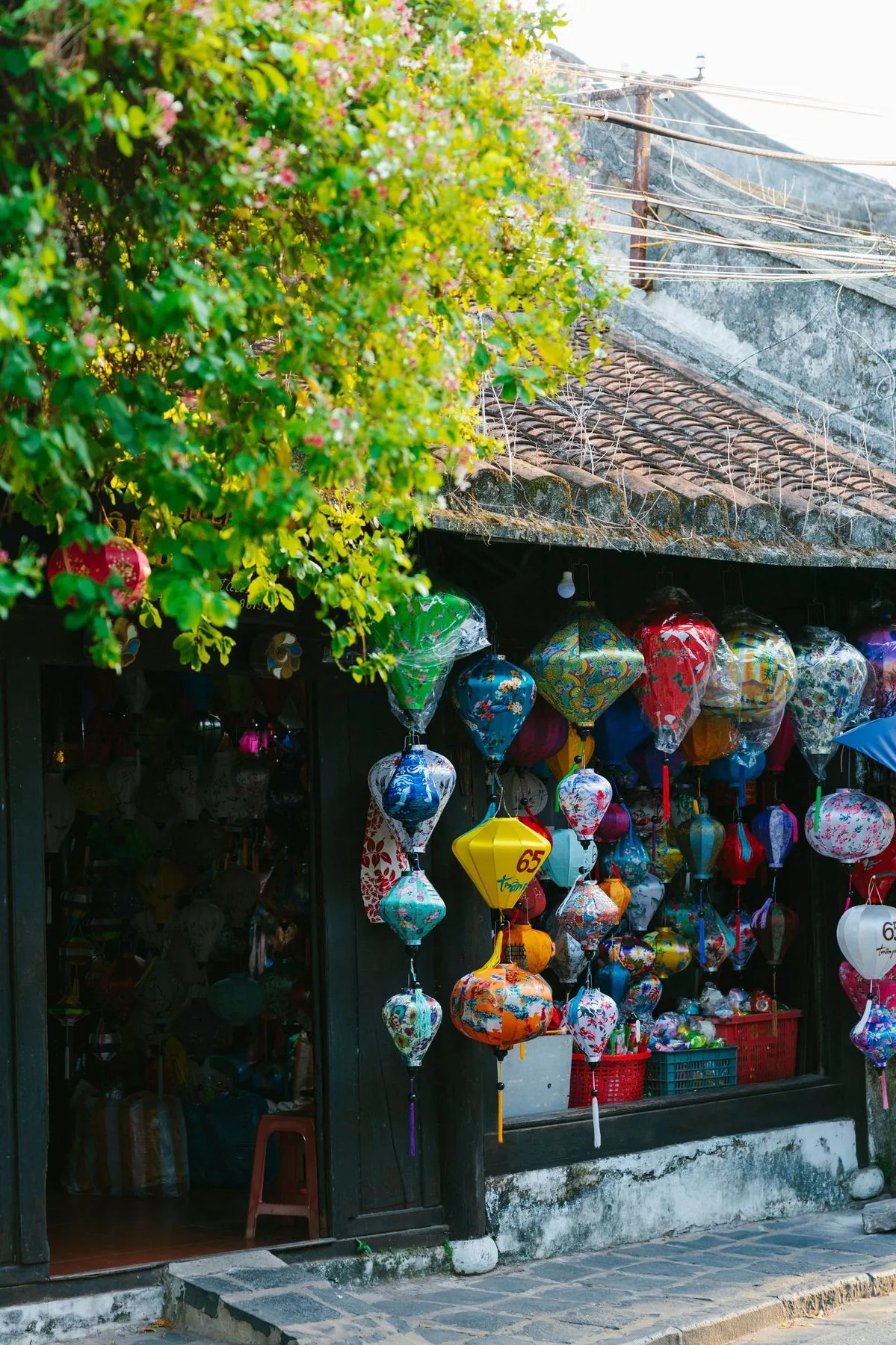
In the dry months of 2027 the 14th falls on Friday 19 February, Sunday 21 March and Tuesday 20 April.5 If your dates miss them, the same guide says weekend evenings, Saturdays above all, feel much the same.3 And if you want to see it from the water, reception can arrange a lantern boat on the Thu Bồn at dusk and will tell you its price before anything is confirmed.
One week needs a second look: the Lunar New Year. In 2027 the official holiday runs from Thursday 4 to Wednesday 10 February,6 and the first day of the new year is Saturday 6 February.5 If your trip touches that week, tell us before you book.
Is summer too hot in Hoi An?
Hot, yes; too hot depends on how you plan the day. From May to August the average high at the Da Nang station is 33 to 34.5 °C, and these are also the sunniest months, with 215 to 247 hours of sun each.1
It is the beach season: the sea is outside its large-wave months, which usually run from September to March.2 What the water in front of the hotel is like, and its swimming rules, is in our guide to Hà My beach.
It is also the thunderstorm season. May has the most days with thunder of the year, eight on average, and June to September keep between six and eight; from May to August it rains on 8 to 12 days a month.1
The way to live it is the local timetable: the beach early and late, and the middle of the day in the shade. Here that means the palms, with hammocks between the trunks and brick paths that stay cool, and the bamboo pavilion at the end of the main pool, the only shade that still works at two in the afternoon.
Should you avoid September to November?
Not necessarily, but go in knowing what it is. From September to December the coast gets 1,645 of its 2,205 mm a year, about three quarters of the rain, and from September to November it rains on 15 to 20 days a month; October alone averages 628 mm.1
The big storms usually come between September and November, and the sea is in its rough season.2 In the big floods, the lower Vu Gia–Thu Bồn basin, Hoi An included, is regularly under 1 to 3 m of water, worst when the river flood meets a high tide.2
There are dry days between the fronts, and a short trip with a free day in the plan can work well. How these months feel away from the beach, and what to do if the river rises, is in our guide to the rainy months.
What are December and January like?
Cooler, and the rain eases off: December still has 19 days of rain on average, January 12.1 Highs sit at 25 °C and nights at 19 to 20 °C, the freshest of the year.1
The sea is still in its large-wave months,2 so this is a season for the old town, the rice fields and long lunches rather than for swimming. On grey days, the spa's indoor treatment rooms, sauna and steam room come into their own.
This December there is one more reason. Da Nang has planned the first Hoi An International Lantern Festival, “Hoi An – Colors of Heritage”, from 3 to 6 December 2026 along the Hoài river and in the old town, with an exhibition of lantern installations expected to stay open until the first full moon of the lunar year.7 That full moon is Saturday 20 February 2027.5

How do you pick your week?
- For the old town and the lanterns: February to April, and if you can, a week with a 14th of the lunar month in it: 19 February, 21 March or 20 April in 2027.5
- For the beach: April to August, with the sand in the morning and late afternoon.
- For both: April.
- From September to December: short trips, a flexible plan and a free day in reserve.
The hotel is open all year and the old town is 12 minutes away, about 8 km, so once you are here you can choose by the weather of each day rather than by the season.
If you are torn between two weeks, send us both and we will check them and tell you which one we would take.
Frequently asked questions
What is the best month to visit Hoi An?
April, if you want the old town and the beach in one trip: it is one of the three driest months of the year and the first one outside the large-wave season. For the old town alone, February and March are just as dry and cooler.
When is the rainy season in Hoi An?
From September to December. Those four months bring about three quarters of the year's rain, October and November have rain on two days out of three, and the big storms usually come between September and November.
When are the lantern nights in 2027?
On the 14th and 15th of each lunar month. In the first half of 2027 the 14th falls on 21 January, 19 February, 21 March, 20 April, 19 May and 18 June.
Is Hoi An too hot in summer?
It is hot: from May to August the average high is 33 to 34.5 °C. Keep the beach for the morning and the late afternoon, and the middle of the day for the shade or the pool.
Is the hotel open all year?
Yes. Tell us your dates before you book and we will tell you honestly what the coast is usually like that week.
Sources
- Ministry of Construction of Vietnam: QCVN 02:2022/BXD, national climate data for construction. Da Nang station: average monthly maximum and minimum air temperature (tables A.3 and A.4), relative humidity (A.10), hours of sunshine (A.22), rainfall (A.25), days with rain (A.28) and days with thunder (A.33). The standard does not state the years the averages cover. (consulted )
- City of Da Nang: the effects of natural hazards and climate change (4 May 2026). Large waves usually from September to March; major storms from September to November; in big floods the lower Vu Gia–Thu Bồn basin, Hoi An included, often under 1 to 3 m of water, especially when the river flood meets a high tide. (consulted )
- City of Da Nang: the Hoi An lantern festival (5 May 2026). Lanterns floated on the Hoài river on the 14th and 15th of each lunar month since 1998; best time in the dry season, March to September; similar atmosphere on weekend evenings, especially Saturdays. (consulted )
- Vietnam National Authority of Tourism: the best ways to explore the ancient town of Hoi An. The lantern festival on the 14th day of every lunar month, when the town reduces its electricity use. (consulted )
- Hong Kong Observatory, 2027 calendar. Gregorian–lunar calendar: the 14th day of each lunar month in 2027, the first day of the lunar year (6 February) and the 15th of the first month (20 February). (consulted )
- Government of Vietnam news portal: the 2027 Lunar New Year holiday lasts seven days (10 October 2026). Official Lunar New Year holiday from Thursday 4 to Wednesday 10 February 2027. (consulted )
- Tuổi Trẻ News: Vietnam's Hoi An to host international lantern festival for the first time in December (31 July 2026). Da Nang's plan for the first Hoi An International Lantern Festival, 3 to 6 December, with an exhibition expected to stay open until the first full moon of 2027. (consulted )